




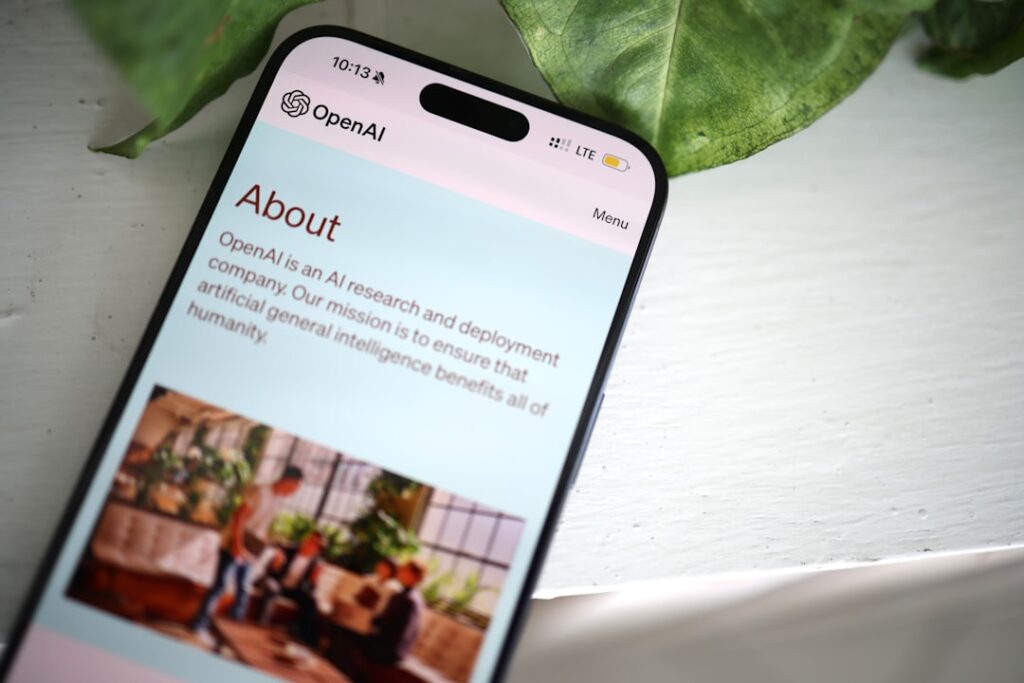
OpenAI is reportedly building its own smartphone — a device designed not around apps or touchscreens, but around AI agents. That’s according to a report published April 27, 2026, by original report, which cites unnamed sources familiar with the company’s plans. The move contradicts years of speculation that AI would render smartphones obsolete. Instead, OpenAI appears to believe the future of mobile isn’t de-appification — it’s re-platforming around autonomous systems that act on your behalf.
Key Takeaways
- OpenAI is developing a smartphone centered on AI agents, not traditional apps.
- The device represents a strategic pivot, suggesting AI enhances rather than replaces mobile.
- No hardware partners have been confirmed, raising questions about OpenAI’s manufacturing capability.
- The project is still in early stages, with no announced release date.
- If true, this marks OpenAI’s most ambitious expansion beyond software and APIs.
AI Was Supposed to Kill the Smartphone
For years, technologists have argued that AI agents would make smartphones irrelevant. The logic went like this: if an AI can book your flight, order groceries, negotiate your cable bill, and summarize your emails without you lifting a finger, why would you need a screen full of icons? Voice assistants like Siri and Alexa were clumsy first attempts, but foundational. Then came generative AI. Suddenly, models could reason, draft, and plan. The dream of ambient computing — where devices recede and intelligence surfaces — felt tangible.
And yet, here we are on April 28, 2026, with OpenAI — one of the driving forces behind that very AI revolution — reportedly building a phone. Not just any phone, but one where the interface is entirely agent-driven. That’s not the death of the smartphone. That’s its reinvention.
What Do We Actually Know?
The details are sparse. The 9to5Google report doesn’t name executives, engineers, or prototypes. It doesn’t cite internal documents or patent filings. What it does offer is a consistent narrative from multiple unnamed sources: OpenAI has initiated a project to create a smartphone where AI agents are the primary mode of interaction.
That means no tapping icons. No swiping between apps. Instead, you’d delegate tasks — “plan a weekend trip to Portland,” “monitor my inbox for urgent requests,” “track down a replacement part for my bike” — and the system’s agents would execute them autonomously, reporting back only when necessary.
How Is This Different From Siri or Bixby?
Past voice assistants were reactive. You ask, they respond. They can’t initiate. They don’t remember context across days. They don’t collaborate with other services unless explicitly coded to. AI agents, as envisioned by OpenAI and others, are proactive, persistent, and goal-oriented.
They’re less like tools and more like employees. One agent might manage your digital subscriptions. Another could negotiate lower rates with service providers. A third might monitor news, forums, and job boards relevant to your career — not just summarizing them, but applying filters based on your long-term goals.
The Hardware Gambit
OpenAI has no experience building hardware. It’s a software and research lab, not a manufacturer. Apple can design chips, manage supply chains, and build retail ecosystems. Google has Pixel. Even Microsoft has Surface. OpenAI? Its closest brush with physical devices was the now-defunct OpenAI Robotics team, shuttered years ago.
So how would it pull this off? The report doesn’t say. But there are a few paths. One: partner with an OEM like Foxconn or Sharp and license the design. Two: collaborate with a tech giant — though tensions with Microsoft over AI control make that unlikely. Three: acquire a struggling mobile company. (HTC? Nothing left of Motorola but the name?)
Or — and this is the most plausible — OpenAI isn’t building the phone at all. Not yet. It’s building the agent framework. It’s proving the concept in simulation. Then, when the software is ready, it either licenses it out or finally hires the hardware team.
What This Means For You
- Agents will need sandboxed execution environments — imagine containers for AI workflows, with strict permissions per task.
- API access will become strategic — companies that control data (banks, airlines, calendars) will decide which agents can act on your behalf.
- Privacy models will shift — continuous monitoring for agent efficiency could mean always-on data streams, raising new consent questions.
- UI design becomes obsolete — if agents act independently, the concept of a “user interface” may dissolve into notifications and summaries.
The Irony of OpenAI’s Bet
There’s something deeply ironic about OpenAI — a company founded to ensure artificial general intelligence benefits all of humanity — betting on a proprietary phone. The smartphone is the ultimate walled garden. Apple controls the App Store. Google controls Android updates. Even if OpenAI builds an open agent protocol, the device itself would likely lock users in.
And let’s be clear: this isn’t just another AI feature layered onto an existing platform. This is a full-stack reimagining. That means OpenAI would have to control the OS, the security model, the agent marketplace, and the hardware. That’s not open. That’s not even particularly AI-native. That’s vertically integrated control — the kind we associate with Apple, not research labs.
The tension is obvious. Can a company that once positioned itself as a counterweight to Big Tech now become one of them? Can it build a phone without replicating the very monopolistic behaviors it once criticized? The answer isn’t in the 9to5Google report. But the question is now unavoidable.
What This Means For You
For developers, this changes the game. If AI agents become the primary interface, app development as we know it could dry up. Why build a travel app if an agent can scrape, compare, and book across dozens of services without installing anything? Your code becomes a target for scraping, not a destination.
But new opportunities emerge. You’ll need to build agent-readable APIs — structured, consistent, permission-aware. You’ll need to design for delegation, not engagement. And you’ll have to decide: do you allow agents to act on your platform, risking loss of direct user relationships, or block them and risk irrelevance?
For founders, the message is clearer: the moat isn’t in the app. It’s in the data, the relationships, and the permissions. If OpenAI’s phone succeeds, the companies that survive are the ones that control access — not screen time.
One thing hasn’t changed: trust. If users are going to let agents manage their lives, they’ll need to know exactly what those agents are doing, where they’re going, and who profits. Transparency isn’t a nice-to-have. It’s the foundation.
What Competitors Are Doing: The AI Agent Race
OpenAI isn’t alone in chasing agent-driven mobile. Google has been quietly advancing its “Assistant Actions” framework, allowing limited automation within Android via predefined triggers. But it’s still user-initiated, lacks persistence, and operates within Google’s own ecosystem. More ambitious is Humane’s AI Pin, launched in 2024, which attempted a screenless interface but stumbled on battery life and reliability. The device sold fewer than 50,000 units by mid-2025, according to internal projections leaked to The Information.
Meanwhile, Samsung has integrated generative AI into Bixby with its Gauss models, but these remain tied to user prompts. Apple, traditionally cautious, acquired AI startup DarwinAI in 2023 and has since filed patents for context-aware agent systems that could monitor user behavior and initiate actions. One 2025 patent describes an AI that schedules meetings based on email sentiment and calendar availability — a step toward autonomy, but still sandboxed.
Startups are also pushing boundaries. Rewind AI, valued at $400 million after a 2025 Series B, offers a personal memory agent that records and indexes device activity. It’s not a phone, but it’s building the kind of always-on awareness required for true agent functionality. The real competition may not be in hardware but in backend infrastructure: startups like Adept and SmythOS are creating agent orchestration platforms that could eventually power devices like the one OpenAI is rumored to be building.
The Bigger Picture: Why This Matters Now
The timing of OpenAI’s move isn’t accidental. By 2026, AI models have crossed a threshold in planning, memory, and tool use. GPT-5, released in late 2025, demonstrated multi-step reasoning across email, calendar, and web APIs in controlled tests. It could book a flight, adjust a meeting, and notify contacts — all without human input. But it ran on cloud infrastructure, not on a personal device. Latency, privacy, and cost made real-time agent execution impractical.
That’s changing. On-device inference is improving rapidly. Qualcomm’s Snapdragon 8 Gen 5, shipping in premium Android phones since early 2026, supports 10 billion-parameter models locally. Apple’s A18 chip includes a dedicated neural engine optimized for real-time LLM execution. These advances make it feasible to run lightweight agent models directly on phones, reducing reliance on cloud processing and addressing privacy concerns.
But more than tech, it’s about control. The companies that own the agent layer will influence how users interact with services. If OpenAI’s agents become the default interface, they could redirect traffic away from apps and websites, siphoning value upstream. Consider this: if an OpenAI agent books your Uber, does Uber pay a fee? Does it get user data? Who negotiates that deal? The smartphone becomes less a consumer product and more a gateway to a new economy of automated delegation.
This shift also reflects broader regulatory currents. The EU AI Act, effective since 2025, requires transparency in autonomous systems. Any device deploying AI agents at scale will need audit logs, consent mechanisms, and fallback modes. OpenAI’s entry into hardware may be as much a compliance play as a strategic one — building a device that meets strict regulatory standards from the ground up, unlike retrofitting existing platforms.
Technical Challenges Ahead
Building a phone around AI agents isn’t just a UX overhaul — it’s a fundamental rethinking of mobile architecture. Today’s smartphones are built for human interaction: touch inputs, visual feedback, multitasking between apps. An agent-first device demands different priorities. Continuous background processing requires new power management models. Qualcomm’s Hexagon NPU helps, but running multiple agents 24/7 could drain batteries in hours without optimization.
Security is another hurdle. If agents can access banking apps, email, and health data, the attack surface widens dramatically. Traditional sandboxing won’t suffice. OpenAI would need to implement zero-trust principles at the OS level, with hardware-backed attestation for every agent action. Apple’s Secure Enclave and Google’s Titan M2 offer blueprints, but integrating them with autonomous workflows is uncharted territory.
Then there’s the coordination problem. Agents must collaborate without stepping on each other. You don’t want one agent canceling a flight while another books a hotel for the same weekend. This requires a central orchestration layer — a “CEO agent” that manages priorities, resolves conflicts, and maintains a coherent user model. Research from DeepMind on multi-agent systems suggests hierarchical planning frameworks could work, but they’ve only been tested in simulation.
Finally, error handling. What happens when an agent fails? If it books the wrong flight or overpays for a service, who’s liable? Refund policies, insurance models, and user recourse mechanisms don’t exist yet. OpenAI would need to build not just software, but a support infrastructure — something no AI company has done at scale.
So here we are — not at the end of the smartphone, but at a crossroads. The device isn’t dying. It’s mutating. And the question isn’t whether AI will replace our phones. It’s whether we’ll recognize the thing that takes their place.
Sources: 9to5Google, The Verge, The Information, Qualcomm, Apple, EU AI Act documentation