




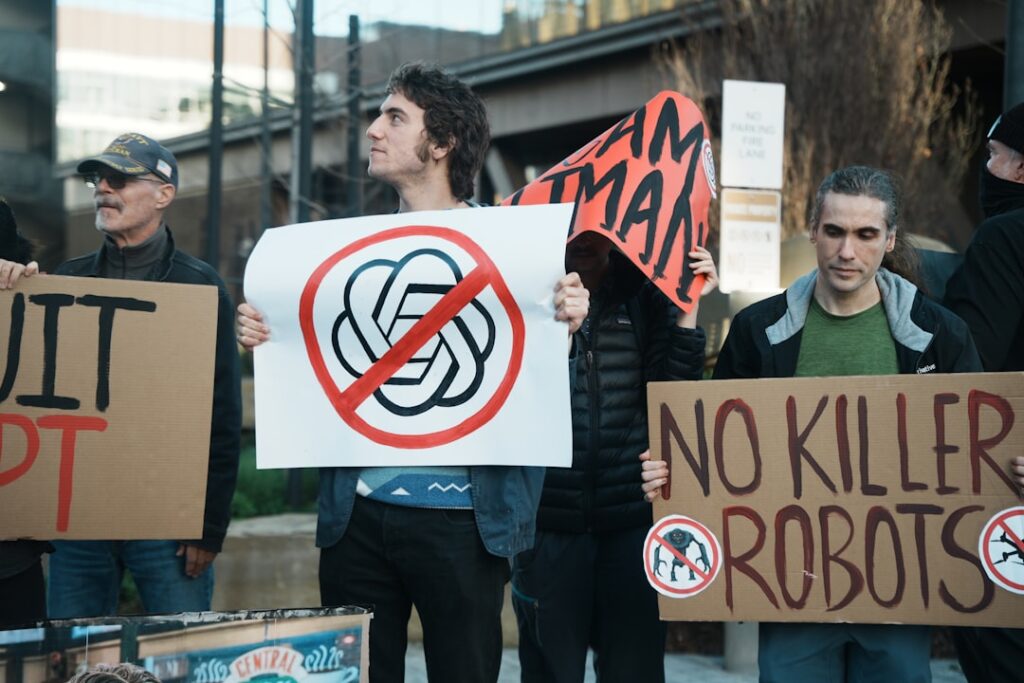
May 09, 2026, will be remembered as the day Elon Musk‘s concerns about AI risks to humanity clashed with the leadership of OpenAI in a high-stakes trial. Musk, known for his outspoken views on the dangers of AI, took the stand to testify that he deliberately chose to create OpenAI as a non-profit organization, citing the public good as his motivation.
That’s a far cry from the allegations against OpenAI, which Musk claims has shifted its focus from promoting the public good to prioritizing profits. The stakes are high, with the trial potentially spelling out the future of AI development and the role of non-profit organizations like OpenAI.
Key Takeaways
- Musk testified that he chose to create OpenAI as a non-profit organization for the public good.
- The trial pits Musk against OpenAI’s leadership over allegations that the company has prioritized profits over public good.
- The stakes are high, with the trial potentially determining the future of AI development.
- Musk claims that OpenAI has shifted its focus from promoting the public good to prioritizing profits.
- The trial is a test of the ability of non-profit organizations to prioritize the public good over profits.
Musk’s Testimony
Musk took the stand to testify that he chose to create OpenAI as a non-profit organization, citing the public good as his motivation. He claimed that he deliberately chose this path, despite the fact that he could have founded OpenAI as a for-profit company, just like the other companies he started or took over.
“I deliberately chose this,” Musk said, “for the public good.”
He emphasized that the original vision for OpenAI, formed in 2015 alongside co-founders including Sam Altman and Ilya Sutskever, was rooted in the idea of developing AI safely and openly, with safeguards built in from the start. The concern at the time was clear: if a small number of for-profit tech giants cornered the AI market, they could control not just the technology but its ethical deployment. Musk argued that a non-profit structure would insulate the organization from investor pressure and allow it to act in humanity’s long-term interest.
During his testimony, Musk referenced internal emails and early mission statements that outlined a commitment to open-source development and equitable access. He pointed to the 2018 decision to release GPT-2 in stages as evidence of the original team’s caution and public-mindedness. At the time, the limited release was defended as a necessary step to prevent misuse, such as automated disinformation campaigns. That kind of restraint, Musk argued, has since disappeared.
OpenAI’s Alleged Shift in Focus
The trial is centered around allegations that OpenAI has shifted its focus from promoting the public good to prioritizing profits. Musk claims that this shift is a result of the company’s growing ambition and its desire to become a major player in the AI industry.
“OpenAI has become a for-profit company, prioritizing profits over the public good,” Musk alleged.
This transformation began in 2019, when OpenAI introduced a “capped-profit” model under OpenAI LP, a structure that allowed private investment while promising to cap returns for investors. Microsoft’s $1 billion investment followed shortly after. Musk argued that this pivot marked the beginning of the end for OpenAI’s original mission. The influx of capital, he said, changed the balance of power within the organization, placing control in the hands of executives and investors rather than researchers driven by ethical considerations.
By 2023, OpenAI had moved away from open-sourcing its largest models, including GPT-4, citing competitive and security concerns. Musk said this decision broke a core promise made at the organization’s founding. What was once intended to be a transparent, collaborative effort had become a closed, proprietary system developed behind corporate walls. He also cited the commercialization of ChatGPT via subscription tiers and enterprise API pricing as evidence of profit-driven behavior.
The trial has brought to light internal debates within OpenAI about model release timelines, safety thresholds, and partnerships with defense contractors. Emails presented in court suggest that leadership delayed safety reviews to meet product launch deadlines. Musk argued that these trade-offs—speed over safety, revenue over transparency—undermine the public trust that OpenAI was built to uphold.
The Stakes are High
The trial is a test of the ability of non-profit organizations to prioritize the public good over profits. If OpenAI is found guilty of prioritizing profits over the public good, it could set a precedent for future AI development and the role of non-profit organizations.
The stakes are high, with the trial potentially determining the future of AI development and the role of non-profit organizations like OpenAI.
The legal framework hinges on whether OpenAI violated its original charter or engaged in deceptive practices by presenting itself as mission-driven while operating like a for-profit enterprise. If the court rules in Musk’s favor, it could force structural changes, financial restitution, or even a reversion to a fully non-profit model. More broadly, it could prompt regulators to scrutinize the governance of hybrid entities in the tech sector.
Legal experts say the case touches on fiduciary duty, charitable intent, and public trust. Non-profits that accept tax-exempt status are expected to serve a public purpose. When such organizations enter lucrative commercial arrangements, questions arise about where their true loyalties lie. OpenAI, despite its capped-profit model, has generated hundreds of millions in revenue—a figure that complicates its claim to public-serving status.
Historical Context
OpenAI launched in December 2015 with a bold mission: to ensure that artificial general intelligence (AGI) benefits all of humanity. The founding team included Musk, Altman, Greg Brockman, Wojciech Zaremba, and others, many of whom came from elite research and tech backgrounds. The initial funding came from a $1 billion commitment by a group of high-profile donors, including Musk himself, who contributed tens of millions.
In the early years, OpenAI operated like a research lab, publishing papers, sharing code, and avoiding productization. It focused on reinforcement learning, game-playing agents, and language models—all while maintaining a strict ethical stance. The organization’s 2018 decision not to release the full version of GPT-2 sparked debate but reinforced its image as a cautious, responsible actor.
The turning point came in 2019. Facing rising compute costs and competition from Google DeepMind and Facebook AI Research, OpenAI announced a restructuring. It created OpenAI LP, a for-profit arm under the umbrella of the original non-profit. This model was designed to attract investment while preserving the mission. But Musk argued that the moment the organization accepted large-scale private capital, its independence was compromised.
Microsoft’s growing involvement—from a $1 billion investment to a $10 billion commitment by 2023—further blurred the lines. The partnership gave Microsoft exclusive licensing rights to OpenAI’s technology, which Musk claims contradicts the principle of broad, equitable access. What began as a hedge against corporate control, he said, became a new form of corporate dependency.
What This Means For You
The trial is a reminder that AI development is not just about creating intelligent machines, but also about ensuring that they are developed and used in a way that prioritizes the public good.
As developers and builders, it’s essential to consider the potential consequences of AI development and ensure that any AI systems we create are developed and used responsibly.
For independent developers, the case highlights the importance of governance in open-source AI projects. If a project starts with public-minded ideals but later accepts venture funding or corporate sponsorship, its priorities can shift overnight. Builders should ask: Who controls the roadmap? Who decides what gets released? Who benefits financially?
For startup founders, the trial underscores the tension between mission and market. Many AI startups begin with ethical charters, but investor pressure can quickly reshape those values. Founders who want to stay true to a public-good mission may need to resist traditional funding models, explore co-op structures, or lock in governance rules early.
For enterprise engineers working inside large tech companies, the case is a warning about complicity. Even if you’re not setting policy, your work can accelerate systems that prioritize engagement, efficiency, or profit over safety and fairness. The trial shows how technical decisions—like withholding model weights or rushing a release—can have legal and ethical consequences down the line.
The Future of AI Development
The trial is also a test of the ability of non-profit organizations to prioritize the public good over profits. If OpenAI is found guilty of prioritizing profits over the public good, it could set a precedent for future AI development and the role of non-profit organizations.
The future of AI development will depend on how the trial pans out and what implications it has for the industry.
Regardless of the verdict, the case has already influenced how new AI labs position themselves. Several organizations have emerged in recent years with strict open-source mandates and transparent governance, partly in response to OpenAI’s perceived drift. Others have adopted “stewardship” models, where independent boards oversee key decisions to prevent mission drift.
Regulators are also paying closer attention. The U.S. Federal Trade Commission has opened inquiries into AI company disclosures, and the European Union is considering rules that would require mission-driven entities to prove their public benefit claims. The OpenAI trial could accelerate regulatory action, especially around labeling, accountability, and financial transparency for AI organizations.
The outcome may also affect talent flows. Many researchers joined OpenAI for its mission. If the court finds that mission was abandoned, it could weaken trust in similar ventures. Conversely, a ruling in OpenAI’s favor might embolden other labs to adopt hybrid models, arguing that commercial success is necessary to fund long-term safety research.
What Happens Next
The trial is expected to last several weeks, with testimony from other co-founders, board members, and AI ethics experts. The court will examine internal documents, financial records, and public statements to determine whether OpenAI violated its founding principles.
One key question is whether the shift to a capped-profit model constitutes a breach of charitable intent. Legal precedent is sparse, but past cases involving non-profits that commercialized operations suggest courts may intervene if public harm is demonstrated.
Another issue is Musk’s standing in the case. While he was a co-founder, he left OpenAI’s board in 2018 and has since launched competing AI ventures, including xAI. OpenAI’s defense is likely to argue that his claims are motivated by competitive interests, not principle.
Whatever the outcome, the trial has already sparked a broader conversation about who gets to shape AI’s future. Is it venture capitalists? Tech billionaires? Independent researchers? The public? The answer could redefine how AI is built—for decades to come.
However: the stakes are high, and the outcome of the trial will have far-reaching consequences for the future of AI development.
What will be the outcome of the trial? Only, but one thing is certain: the future of AI development hangs in the balance.
Sources: SecurityWeek, AI News