




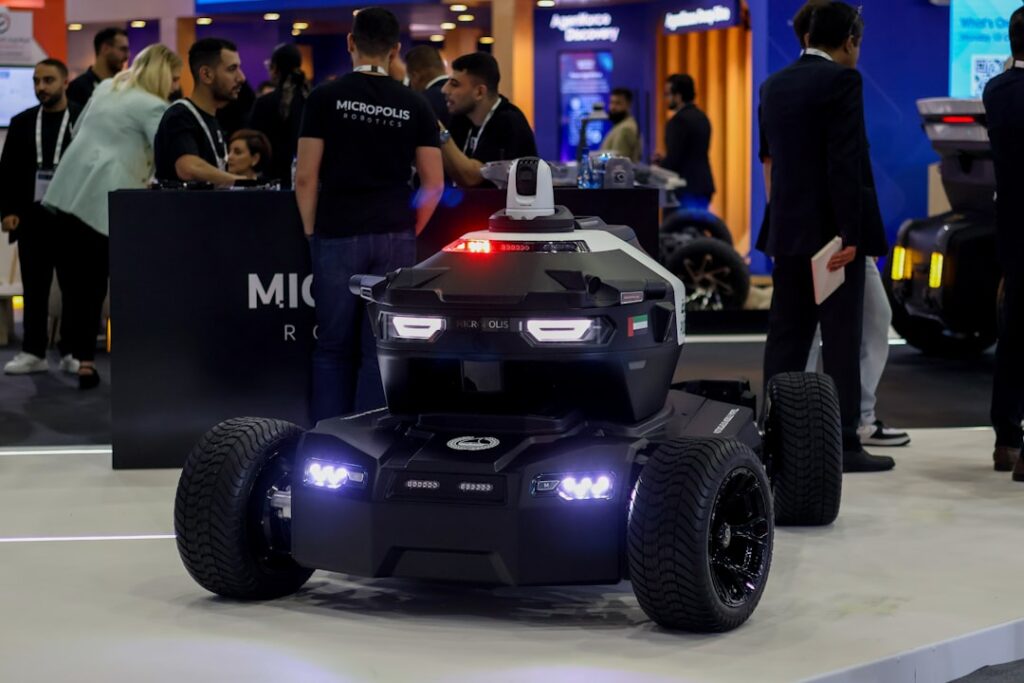
100 million dollars. That’s the number the White House didn’t flinch at when Scout AI closed its latest round on May 04, 2026. The startup, operating in the tightly guarded intersection of artificial intelligence and national defense, says it’s building an “AI brain” for autonomous warfare systems—software that doesn’t just assist soldiers but makes lethal decisions in real time, without human input.
Key Takeaways
- Scout AI raised $100 million on May 04, 2026, to accelerate development of autonomous combat AI.
- The funding reflects the White House’s intensified push for U.S. dominance in military AI, particularly in unmanned systems.
- The company is building what it calls an “AI brain”—a decision-making core for drones, ground vehicles, and sensor networks.
- Unlike traditional defense contractors, Scout AI operates with startup speed and minimal public oversight.
- The ethical and operational risks of fully autonomous weapons are mounting as deployment timelines shorten.
The AI Brain Isn’t a Metaphor
Scout AI isn’t talking about machine learning models that flag anomalies or optimize logistics. Their “AI brain” is designed to process battlefield data—radar, thermal feeds, comms intercepts—and initiate kinetic responses. That means identifying a target, assessing threat level, and authorizing engagement. All in under 800 milliseconds, according to internal benchmarks cited in the original report.
It’s not a distributed system relying on cloud compute. It’s embedded. Onboard. Self-contained. The AI runs locally on hardened hardware so it functions even when GPS is jammed or satellite links are down. That’s critical in contested environments—think Taiwan Strait, Baltic borders, or urban conflict zones where signal blackout is assumed.
And that’s what makes this different from Raytheon’s AI targeting tools or even Project Maven’s image classifiers. Scout AI isn’t building a copilot. It’s building the pilot.
Why AI in the Military Matters
The funding and development of AI in the military is not just about technological advancements; it’s also about the changing nature of warfare. Conflicts are becoming increasingly asymmetrical, with non-state actors and terrorist organizations using tactics like guerrilla warfare and drone strikes. The ability to quickly adapt and respond to these threats is crucial, and AI is seen as a key tool in achieving that.
The integration of AI in the military is also driven by the need to counter the growing threat of advanced technologies, such as hypersonic missiles and advanced cyber capabilities. As these threats become more sophisticated, the military needs to be able to respond quickly and effectively, and AI is seen as a key enabler of this capability.
The use of AI in the military is also a key aspect of the broader national security strategy. The ability to use AI to support military operations is seen as a key component of the country’s overall defense posture, and is being viewed as a critical area of investment by the Pentagon.
Startup Speed, Battlefield Consequences
Legacy defense firms move slowly. Lockheed Martin’s F-35 program took 22 years from contract to full deployment. Scout AI’s founders know they don’t have that kind of runway. They’re shipping quarterly updates. Deploying new models every 90 days. Pushing code to hardware in the field like a Silicon Valley SaaS company—except the software can decide to fire a missile.
Investors see that agility as an edge. The $100 million round was co-led by In-Q-Tel, the CIA’s venture arm, and Valor Capital, a firm with deep ties to Special Operations Command. That’s not just funding. It’s validation from entities that deploy in real conflicts.
“We’re not waiting for requirements documents,” said Ava Rens, Scout AI’s CTO, in a rare interview last year. “We’re building what the battlefield will demand in 18 months, not what the Pentagon requested in 2022.” That quote—cited in AI Business—says everything. They’re not serving the customer. They’re outpacing it.
No Humans in the Loop, Just at the Edges
The term “human-in-the-loop” has been the ethical firewall for autonomous weapons. But Scout AI’s architecture assumes that loop is broken. Too slow. Too vulnerable to disruption.
Instead, they use “humans at the edges”—people who train the models, validate edge cases, and set engagement parameters. But once deployed, the AI operates independently. That’s not speculation. It’s in their technical whitepapers, which describe “closed-loop operational modes” for high-threat scenarios.
That shift—from oversight to setup—is where the danger lies. Because once the thresholds are defined (e.g. “engage any fast-moving object within 500 meters of forward position”), the AI doesn’t negotiate. It executes.
The White House Push Isn’t Subtle
On May 04, 2026, the same day Scout AI announced its raise, the National Security Council released a declassified slide deck titled *AI Integration in Defense Systems: 2026–2030*. It included a roadmap for “full autonomy in non-strategic combat roles” by 2028. That means drone swarms, perimeter defense turrets, and electronic warfare platforms making real-time decisions without human approval.
The document isn’t a request for proposals. It’s a directive. And it names Scout AI as one of three “accelerated capability partners.” That’s not a contract. It’s a signal. The government isn’t just watching. It’s betting.
And it’s not alone. Australia, Japan, and Poland have all signed bilateral AI defense agreements with U.S. startups in the past six months. Scout AI is reportedly in talks with all three. The global arms race isn’t just about who has more nukes. It’s about who has faster AI.
What the Code Actually Does
Based on available technical disclosures, Scout AI’s system runs on a hybrid architecture:
- Real-time sensor fusion: Merges input from RF detectors, lidar, acoustics, and EO/IR cameras.
- Threat graph engine: Builds dynamic networks of suspected hostile entities, assigning confidence scores.
- Autonomous engagement scheduler: Determines optimal moment to act based on risk, rules of engagement, and mission priority.
- Adversarial learning layer: Detects and adapts to spoofing, deception, and model poisoning attempts.
The system doesn’t just react. It learns mid-mission. If it sees a new drone signature or a novel jamming pattern, it updates its model on the fly. That’s not theoretical. It’s baked into the architecture.
The Role of Venture Capital in Defense Tech
The role of venture capital in the defense tech industry is a complex one. On the one hand, VC firms like In-Q-Tel and Valor Capital are providing critical funding to startups like Scout AI, allowing them to develop and deploy new technologies at a rapid pace. On the other hand, the close relationships between these firms and government agencies can create conflicts of interest and blur the lines between private enterprise and public policy.
The defense tech industry is a unique space, where the lines between private and public are often blurred. The Pentagon has a long history of partnering with private companies to develop new technologies, and the use of venture capital is a key part of this strategy.
The $100 million raise by Scout AI is a prime example of this trend. By partnering with VC firms like In-Q-Tel and Valor Capital, Scout AI is able to access critical funding and expertise, allowing it to accelerate its development and deployment of autonomous warfare systems.
The Bigger Picture
The development and deployment of AI in the military is a complex issue, with far-reaching implications for national security, ethics, and the future of warfare. As AI becomes increasingly integrated into military operations, it raises important questions about accountability, transparency, and the role of human oversight.
The normalization of autonomous decision-making in lethal contexts is a concerning trend, as it blurs the lines between human and machine decision-making. The use of AI in the military also raises important questions about the role of human values and ethics in the development and deployment of AI systems.
As the world becomes increasingly interconnected, the use of AI in the military is a critical area of investment for national security. However, it is also a complex issue that requires careful consideration of the ethical implications of this technology.
What This Means For You
If you’re building AI systems—even in logistics, healthcare, or consumer apps—Scout AI’s trajectory should unsettle you. The normalization of autonomous decision-making in lethal contexts changes the Overton window for all AI. If it’s acceptable for a drone to kill without human approval, what stops a financial model from liquidating assets without oversight? Or a medical triage system from deprioritizing patients during a crisis?
And if you’re a developer working in defense-adjacent AI, your choices matter more than ever. The tools you build, the assumptions you bake into models, the edge cases you ignore—those aren’t abstract. They’re operational specs. The next time you design a reinforcement learning agent that optimizes for survival or mission success, ask: what happens when “success” includes killing?
Autonomous warfare isn’t science fiction. It’s funded. It’s deployed. It’s evolving faster than the ethics frameworks meant to contain it.
Sources: AI Business, Defense One