


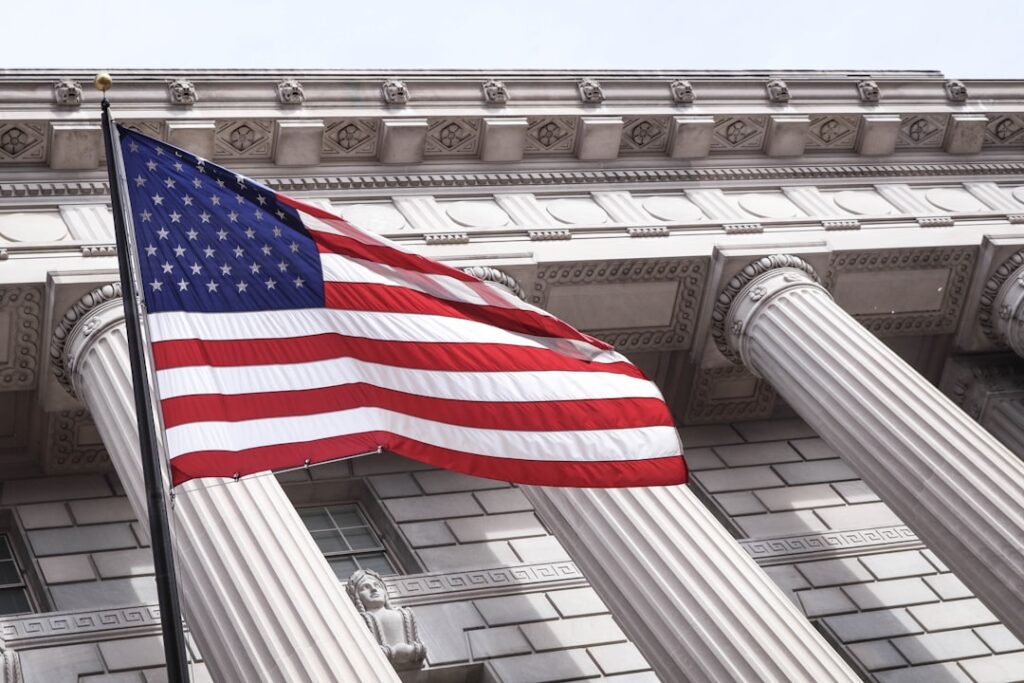
The Trump administration is vowing to crack down on foreign tech companies’ exploitation of U.S. artificial intelligence models, a move that’s both concerning and remarkable given the current geopolitical climate.
Key Takeaways
- The Trump administration aims to protect American AI innovations from foreign exploitation.
- This move is driven by national security concerns.
- Foreign tech companies, especially Chinese ones, are the primary targets of this crackdown.
- The specifics of the crackdown are not yet clear.
Background and Motivations
And that’s what makes this story so intriguing – the fact that the Trump administration is taking a strong stance on AI exploitation. Because AI is a critical component of modern technology, it’s no surprise that the US wants to safeguard its innovations. But what’s driving this crackdown, and how will it affect the global tech landscape? The answer lies in a mix of economic competition, intelligence risks, and long-term strategic positioning. U.S. officials have expressed growing concern that foreign actors, particularly from China, are gaining access to foundational AI models developed in American labs—models trained on vast datasets, often funded by U.S. taxpayers or private capital, and built using advanced hardware. These models aren’t just tools for automation or customer service—they power surveillance systems, military simulations, and cyber warfare tools abroad. If Beijing integrates U.S.-developed AI into its defense or intelligence infrastructure, it could erode America’s technological edge. The National Security Council has flagged multiple instances where Chinese firms accessed U.S. open-source AI codebases, then retrained and weaponized them for domestic surveillance. This isn’t theoretical. In 2024, the Department of Commerce found that a state-linked Chinese semiconductor firm used modified versions of Meta’s Llama 2 to enhance facial recognition accuracy in Xinjiang. These findings helped fuel the push for tighter controls.
Implications for Foreign Companies
But for foreign companies, especially those in China, this crackdown could have significant implications. It’s likely that these companies will face stricter regulations and oversight when dealing with US AI models. And that could limit their ability to access and utilize American innovations, which could, in turn, hinder their own growth and development. The restrictions may not just apply to direct downloads of models. The U.S. government could extend export controls to cloud-based AI inference services, preventing Chinese developers from using American APIs to run AI workloads. That would affect companies like Alibaba Cloud and Tencent AI Lab, which have relied on access to U.S. model hosting platforms to train their own downstream applications. The Bureau of Industry and Security (BIS) is reportedly considering updating the Export Administration Regulations (EAR) to classify certain AI model weights above a specific parameter threshold—say, 48 billion parameters or higher—as dual-use technologies. If finalized, this would require U.S. firms to obtain licenses before sharing those models with foreign entities, even if the model is technically “open source.” That could upend the current open-AI movement, where companies like Mistral and Meta have released model weights publicly. For Chinese AI startups, this means a harder path to scaling. Many have built their platforms by fine-tuning American models with local data. Without that access, they’ll need to invest heavily in independent research or turn to less advanced domestic alternatives.
Chinese Companies in the Crosshairs
The Trump administration’s move is largely seen as a response to China’s growing technological prowess. Chinese companies have been aggressively expanding their presence in the global tech market, often by using American innovations. But now, it seems that the US is pushing back, and that’s likely to have significant consequences for these Chinese companies. Firms like SenseTime, Megvii, and Huawei have all leveraged U.S.-developed deep learning frameworks—such as TensorFlow and PyTorch—to accelerate their R&D. While these frameworks remain legal to use, the models trained on them are becoming a regulatory gray zone. The Commerce Department has already blacklisted over a dozen Chinese AI firms since 2019, citing human rights abuses and military ties. This new wave of restrictions could expand that list. Baidu, for instance, recently launched its ERNIE Bot 4.5, which bears striking architectural similarities to GPT-4. U.S. intelligence analysts have raised concerns that Baidu may have used leaked training data or model outputs from American systems to shortcut development. Whether or not that’s true, the perception alone is enough to justify heightened scrutiny. The timing is also significant. With the 2028 U.S. presidential election cycle heating up, Trump and his advisors may be using this issue to appeal to voters worried about China’s rise. Tech protectionism plays well in swing states with manufacturing and tech sectors, like Ohio and Wisconsin.
Industry Response and Competitive Landscape
Major U.S. tech firms are reacting cautiously to the administration’s signals. Google and Microsoft have publicly supported responsible AI development but stopped short of endorsing export bans. Both companies generate substantial revenue from cloud AI services in Asia, and heavy-handed restrictions could trigger retaliatory measures. In 2025, after the U.S. blocked NVIDIA from selling its H100 chips to China, Beijing responded by launching a 34% tariff on imported cloud computing services—a move that cost Microsoft Azure and AWS an estimated $720 million in lost revenue that quarter. Now, with AI models themselves potentially in the crosshairs, American firms are bracing for blowback. Amazon Web Services has quietly begun offering “region-locked” model access, allowing only approved users in certain countries to interact with its Titan family of models. Meanwhile, startups like Anthropic and Cohere are positioning themselves as compliant alternatives, emphasizing their adherence to U.S. data sovereignty standards. On the other side, Chinese firms are accelerating self-reliance. The Chinese Ministry of Science and Technology has committed $28 billion to its National AI Innovation Program, aiming to produce a fully domestic large language model stack by 2027. Huawei’s Ascend AI chips and the Pangu model are central to that effort. But even with massive investment, China still lags in training infrastructure. U.S. sanctions have cut off access to advanced GPUs, forcing Chinese labs to train models on older A100 chips or build custom accelerators. That slows progress and increases costs. The result is a fragmented AI ecosystem—one where innovation is increasingly siloed along geopolitical lines.
Technical and Policy Dimensions
Enforcing AI model restrictions presents significant technical and legal hurdles. Unlike physical goods, AI models are digital artifacts—lines of code and numerical weights that can be copied, shared, or reconstructed with relative ease. The U.S. government can’t simply “seize” a model once it’s released. Instead, it must rely on licensing, monitoring, and enforcement mechanisms. One approach under discussion involves watermarking AI outputs. If every response from a U.S.-developed model contains a cryptographic signature, authorities could trace unauthorized usage. But watermarking isn’t foolproof. Researchers at Tsinghua University demonstrated in early 2026 that simple rephrasing and distillation techniques could strip out digital signatures from models like GPT-4 and Claude 3. Another idea is to regulate compute. The U.S. could require AI training runs above a certain scale—say, 10^25 FLOPs—to be registered with the Department of Energy. That would create a paper trail. But enforcement depends on cooperation from cloud providers, and many training jobs are already distributed across international data centers. On the policy side, the lack of a unified AI regulatory framework complicates matters. The U.S. currently has no federal AI law. Instead, oversight is split between the FTC, NIST, the Department of Commerce, and the White House Office of Science and Technology Policy. That fragmentation makes coordinated action difficult. By contrast, the European Union’s AI Act, which took effect in 2025, establishes clear categories of high-risk systems and mandates transparency for model developers. The U.S. approach appears more reactive—driven by national security than consumer protection. That could create inconsistencies, especially as global firms navigate multiple regulatory regimes.
The Bigger Picture
This isn’t just about trade or technology. It’s about who controls the foundational tools of the 21st century. AI is no longer a niche research field—it shapes everything from financial markets to military strategy. By restricting access to its most advanced models, the U.S. is trying to maintain a strategic buffer. But there’s a risk. Overly aggressive controls could backfire. They might push adversaries to innovate faster, while alienating allies who rely on American AI tools. South Korea, Japan, and Germany have all expressed concern about unilateral U.S. restrictions. They want coordinated standards, not fragmented rules. Also, limiting open research could stifle global innovation. Many breakthroughs in AI—like transformers and diffusion models—emerged from shared knowledge. If the U.S. walls off its research, it may slow progress everywhere, including at home. And there’s the question of definition: what counts as “exploitation”? Is it acceptable for a Canadian researcher to fine-tune a U.S. model for medical diagnostics? What about a Nigerian startup using an open model to improve agricultural yields? The administration will need clear, enforceable criteria. Otherwise, the crackdown could devolve into arbitrary enforcement. This moment mirrors the 1980s, when the U.S. restricted semiconductor exports to the Soviet Union. That worked in the short term, but eventually spurred Moscow to build its own chip industry. The same could happen with AI. The goal shouldn’t be isolation—it should be sustainable leadership through innovation, not just restriction.
What This Means For You
So, what does this mean for developers and builders who work with AI models? Well, for starters, it’s likely that there will be more stringent regulations and guidelines around the use of US AI models. That could make it more difficult for foreign companies to access these models, which could, in turn, limit the growth of the global AI ecosystem. But it could also create new opportunities for American companies, as they may be better positioned to capitalize on the growing demand for AI innovations. Independent developers using platforms like Hugging Face or Replicate may soon need to verify their location or comply with usage audits. Commercial users could face licensing fees or export compliance checks. This shift will hit smaller teams hardest—those without legal departments or compliance infrastructure. On the flip side, U.S.-based AI startups may benefit from reduced competition and preferential access to government contracts. The Department of Defense’s Project Maven is already prioritizing vendors that use domestically trained models. Venture capital firms are taking note. Sequoia Capital and Andreessen Horowitz have both launched new funds focused on “sovereign AI”—models built, trained, and hosted entirely within U.S. borders. That’s a sign of where the market is headed. Whether this leads to stronger innovation or a more fractured tech world remains to be seen.
And as we consider the implications of this crackdown, it’s worth thinking about the potential consequences for the broader tech industry. Will this move spark a new wave of protectionism, or will it simply serve as a necessary measure to safeguard American innovations? Either way, it’s clear that the Trump administration’s crackdown on AI exploitation is a story that will continue to unfold in the coming months and years.
Looking Ahead
Because the specifics of the crackdown are still unclear, it’s difficult to predict exactly how this will play out. But one thing is certain – the Trump administration’s move marks a significant shift in the global tech landscape. And as we move into the future, it’s likely that we’ll see more efforts to regulate and oversee the use of AI models, both in the US and abroad. The upcoming G7 summit in June 2026 is expected to include AI governance on its agenda, with the U.S. pushing for a coalition approach to model access. If successful, that could lead to a NATO-style agreement on AI sharing among allied nations. But if diplomacy fails, we could see a more isolated, adversarial tech environment—one where AI becomes another front in the U.S.-China rivalry. As of April 27, 2026, the situation is still developing, and it’s unclear what the ultimate outcome will be. But for now, it’s clear that the Trump administration is serious about cracking down on AI exploitation, and that’s likely to have far-reaching consequences for the global tech industry. You can read more about the original report to stay up-to-date on this developing story.
What will be the ultimate impact of this crackdown on the global AI ecosystem, and will it achieve its intended goal of safeguarding American innovations?
Sources: SecurityWeek, The New York Times