




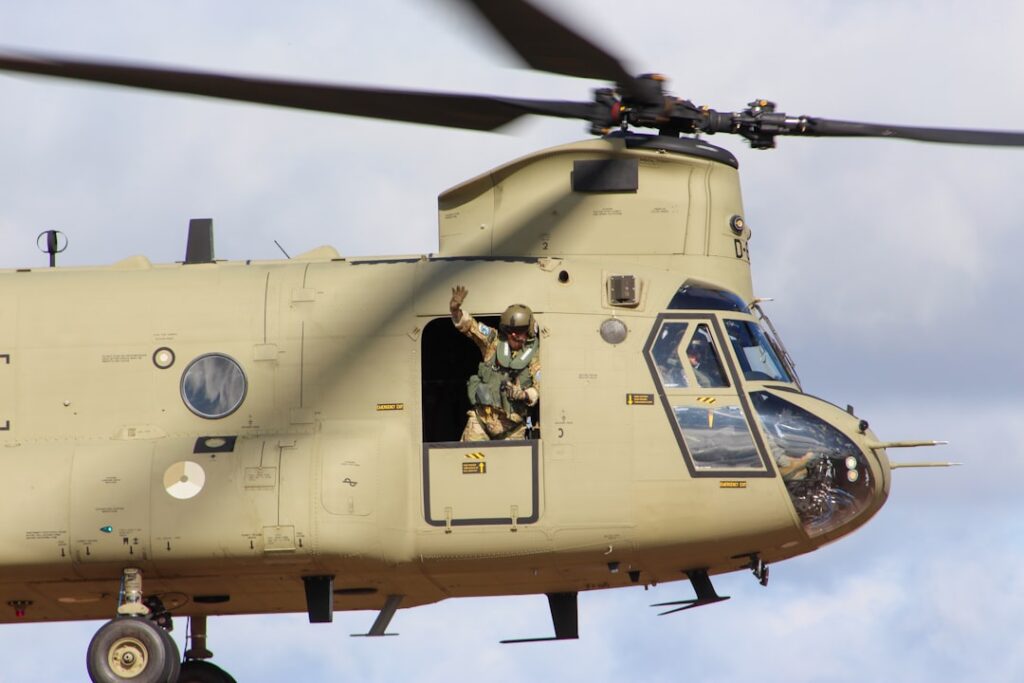
45,000 pounds. That’s the maximum gross weight the CH-47F Chinook can lift, according to TechRadar’s April 28, 2026 report—a figure that’s not just a spec sheet footnote. It’s the foundation of a radical idea: turning the twin-rotor helicopter, a Vietnam-era workhorse still flying combat missions today, into a high-altitude drone mothership.
Key Takeaways
- The CH-47 Chinook’s 45,000-pound payload capacity is being leveraged to explore drone launch and recovery systems.
- Boeing and U.S. Army partners are testing concepts that turn the Chinook into a mid-air drone deployment platform.
- Modifications include external hardpoints and internal mission systems to manage swarms of small UAS.
- Power, data bandwidth, and rotor downwash remain unresolved technical constraints.
- The project signals a shift toward legacy airframes as force multipliers in autonomous warfare.
Not Just a Helicopter—An Aerial Aircraft Carrier
The Chinook was never designed to launch drones. Its job was troops, cargo, artillery. But in 2026, that mission is expanding. Engineers are rethinking the aircraft not as a transport, but as a mobile command node—one that can drop sensors, loitering munitions, and reconnaissance drones behind enemy lines without landing.
That’s the core of the drone mothership concept: use the Chinook’s unmatched lift and range to carry multiple drones deep into contested airspace, then release them en masse. The drones fly their missions. The Chinook returns to base. No forward base needed. No vulnerable ground crews.
It’s a practical workaround. The Pentagon wants more drones. But it doesn’t have enough specialized motherships. The MQ-25 Stingray handles carrier launches. The MQ-9 Reaper operates from runways. But for rugged, forward-deployed, short- or unprepared-field operations, the Chinook is already there—on every major Army aviation roster.
Boeing’s Quiet Push Into Autonomous Swarming
Boeing, the Chinook’s manufacturer, hasn’t issued press releases or flashy demos. But according to the TechRadar report, internal teams have been prototyping drone integration kits since 2024. These aren’t theoretical studies. They’re hardware packages: external pylons that can carry drone pods, internal touchscreen mission consoles, and data links capable of managing dozens of small unmanned aircraft.
One configuration under review allows the Chinook to carry up to 24 Class 1 drones—think AeroVironment’s Jump 20 or Anduril’s Roadrunner—on underwing racks. Another explores belly-mounted launch tubes, similar to how submarines deploy UUVs.
Why the Chinook? Because It’s Already Everywhere
There are over 400 CH-47Fs and MH-47Gs in active U.S. service. They’re in Europe. They’re in the Pacific. They’re in training bases and combat zones. Retrofitting them is faster and cheaper than building new motherships from scratch.
And unlike the V-22 Osprey, the Chinook has a wide cabin, rear loading ramp, and proven ability to operate in high-heat, high-altitude environments. That matters. You can’t launch a drone swarm from an aircraft that can’t get to the launch point.
Real-World Limits: Power, Bandwidth, and Physics
But this isn’t plug-and-play. The Chinook’s electrical system wasn’t built to power a swarm command center. Running multiple data links, cooling avionics, and charging drone batteries mid-flight demands more juice than the current 60 kVA generators can reliably deliver.
- The aircraft generates 60 kVA of electrical power—enough for standard comms and sensors, but tight for swarm control.
- Line-of-sight radio links limit drone control to 50–70 miles, depending on terrain.
- Rotor downwash can destabilize small drones during release—especially from the rear ramp.
- No standardized drone interface exists, forcing custom integration for each UAS model.
There’s also the issue of recovery. The current concept is “launch and leave”—drones fly one-way missions. But true mothership capability requires retrieval, which the Chinook isn’t equipped to handle. Mid-air capture? Too risky. Ground recovery? Defeats the purpose.
The Army’s Stopgap Strategy for Drone Dominance
The U.S. Army isn’t waiting for a bespoke drone carrier. It’s repurposing what it has. The Chinook transformation is part of a broader push to field drone swarming capability by 2027, driven by lessons from Ukraine and tensions in the South China Sea.
Autonomous swarms are no longer sci-fi. They’re tactical tools. And the Army needs platforms that can deploy them at scale, on short notice, using existing logistics chains. The Chinook fits that bill—just not out of the box.
That’s why the service is funding small contracts through programs like the Army Rapid Capabilities and Critical Technologies Office (RCCTO). These aren’t billion-dollar programs. They’re targeted modifications—“if it works, scale it; if not, move on.”
Legacy Platforms as Force Multipliers
What’s happening to the Chinook isn’t unique. The B-52 Stratofortress now carries hypersonic missiles. The MQ-1C Gray Eagle is being used as a command node for smaller drones. The trend is clear: instead of retiring old platforms, the military is turning them into networked hubs.
The irony isn’t lost on anyone: the Army is advancing autonomous warfare by bolting new tech onto airframes designed before microchips. But that’s the reality of defense procurement. You don’t always get the ideal system. You modify what you’ve got.
And in this case, it might be smarter. A drone mothership built from scratch would take a decade and cost billions. A modified Chinook could be fielded in 18 months. It won’t be perfect. But it’ll be there when needed.
How Competitors Are Approaching Aerial Drone Launch
The U.S. isn’t the only military experimenting with airborne drone deployment. China’s AVIC has tested a modified Y-20 transport aircraft launching small reconnaissance drones from its cargo bay, mimicking early Cold War U.S. experiments with the C-130. Russia, meanwhile, has displayed conceptual models of Mi-26 heavy-lift helicopters carrying drone pods, though no live tests have been confirmed. Israel’s Elbit Systems has taken a different route—focusing on mid-air retrieval using autonomous grappling systems mounted on unmanned pods, a capability the U.S. has explored but not yet deployed.
Meanwhile, private-sector efforts are gaining traction. Anduril Industries, under a $37 million contract with the Air Force Research Lab, is developing the “Ghost Fleet” concept using retired F-16s as drone motherships. These jets are retrofitted with AI pilots and modular payload bays capable of launching and coordinating up to eight small UAS. While the scale is smaller than the Chinook’s potential, the Ghost Fleet program demonstrates how aging platforms can be reactivated as autonomous launch platforms without major redesign.
What sets the Chinook effort apart is its integration into existing Army aviation squadrons. Unlike specialized testbeds, the CH-47F is already maintained by Army crews, supported by established supply chains, and compatible with forward-deployed infrastructure. That reduces the training and sustainment burden—a critical factor when deploying under pressure in high-threat environments.
The Bigger Picture: Why Drone Swarming Can’t Wait
The urgency behind the Chinook drone mothership push isn’t just technological. It’s geopolitical. In Ukraine, both sides have used drone swarms to saturate air defenses, destroy armored columns, and conduct surveillance at minimal cost. A single Lancet loitering munition costs around $50,000; a main battle tank it destroys is worth $4 million. That math is impossible to ignore.
In the Pacific, the challenge is different. The vast distances between islands make traditional basing impractical. The Pentagon’s “lily pad” strategy relies on mobile, temporary launch points—exactly the kind of environment where a Chinook can land, launch drones, and take off before enemy forces respond. In a 2025 war game at Pacific Air Forces’ exercise Cope North, a simulated CH-47 launched 18 Roadrunner drones to map a contested atoll, relaying targeting data to long-range missile batteries within 12 minutes. That speed and flexibility are becoming operational requirements, not just experimental goals.
The Army’s goal isn’t to build a perfect system. It’s to field something that works before 2027. The conflict in Ukraine has proven that drone swarms don’t need flawless autonomy to be effective. They need to be deployable, affordable, and integrated with existing command structures. The Chinook, for all its age, offers a ready-made solution—one that can be upgraded incrementally as power systems, data links, and recovery methods evolve.
What This Means For You
If you’re building drone control software, this shift changes your deployment targets. You’re no longer optimizing just for ground stations or fighter jets. You’re designing for a vibrating, noisy, bandwidth-limited environment like the Chinook’s cabin. That means ruggedized hardware, low-latency mesh networking, and fault-tolerant swarm logic.
For founders in the defense space, the message is clear: integration beats invention. The Army doesn’t need another drone. It needs drones that work with existing aircraft. If your system can plug into a Chinook’s power and comms architecture—or adapt to its constraints—you’ve got a real shot at a contract.
One thing is certain: the future of drone swarming isn’t just in the lab. It’s in the cargo bay of a 60-year-old helicopter, flying low over a training range on April 28, 2026, preparing to unleash a cloud of autonomous machines into the sky.
Sources: TechRadar, Defense News