




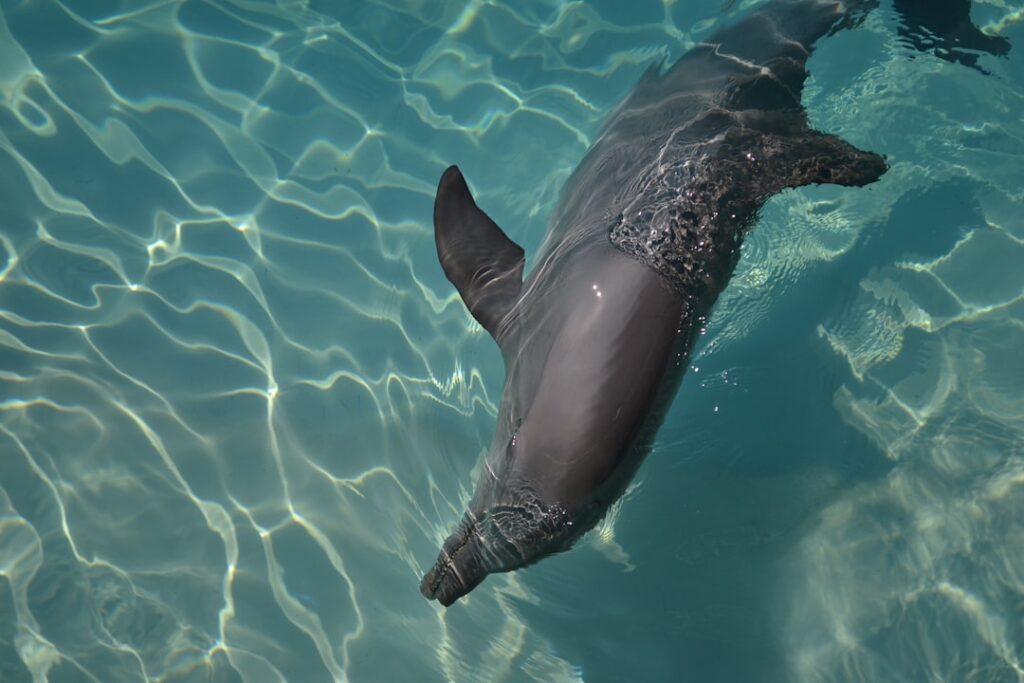
On April 17, 2026, a paper published in Physical Review Fluids quietly dropped an answer to a decades-old question: how do dolphins swim so fast? The answer isn’t muscle. It’s vortices.
Key Takeaways
- Japanese researchers from Osaka University used supercomputer simulations to model dolphin tail movements and water flow dynamics.
- The primary source of thrust comes from large vortex rings generated during the initial tail flap, not continuous kicking.
- Smaller vortices form afterward but contribute nothing to forward motion — they’re hydrodynamic noise.
- These findings challenge long-held assumptions about aquatic propulsion and could influence underwater vehicle design.
- The simulations required massive computational power, highlighting the growing role of high-performance computing in biomechanics.
The Thrust Isn’t in the Tail — It’s in the Wake
For years, engineers and marine biologists assumed that dolphins achieved their exceptional speed — up to 10 meters per second in short bursts — through sheer muscular power and efficient fluke shape. But real power isn’t just in the push. It’s in what the push leaves behind.
The Osaka team didn’t use live dolphins. They didn’t need to. Instead, they built a highly detailed digital model of a dolphin’s tail motion, based on high-speed footage and known kinematic data. Then they set it loose in a virtual fluid environment, running simulations on one of Japan’s most powerful supercomputers.
What emerged was a breakdown of the fluid dynamics at play with millisecond precision. When a dolphin kicks its tail upward or downward, it doesn’t just displace water. It organizes it. The initial motion generates a large, coherent ring of swirling water — a vortex ring — that rolls off the trailing edge of the fluke. This ring, the simulation showed, is where the thrust happens.
“The large-scale vortices are responsible for propulsion,” the authors wrote. “Smaller vortices emerge later but do not contribute significantly to thrust generation.” That’s not just a detail. It’s a major change in how we understand aquatic locomotion.
Why Smaller Vortices Don’t Matter
It sounds counterintuitive. In many fluid systems, turbulence and small eddies are seen as sources of inefficiency — wasted energy. But here’s the twist: the Osaka simulations revealed that the smaller vortices aren’t just inefficient. They’re irrelevant.
After the primary vortex ring forms, the flow field becomes unstable. Secondary instabilities arise. Tiny whirlpools spin off into the wake. These look chaotic. They occupy space in the simulation. But when the researchers measured momentum transfer, they found zero net contribution to forward motion from these smaller structures.
This lack of contribution is crucial. For years, engineers have tried to improve propeller efficiency by adding smaller, more intricate designs. But these eddies only create drag. They don’t propel. In other words, they’re a waste of design effort.
The researchers also discovered that as dolphin speed increases, the primary vortex ring grows. However, the smaller vortices remain negligible. This suggests that for optimal performance, underwater vehicles should focus on creating a single large vortex, not a cluster of smaller ones.
From Fluid Theory to Biological Reality
This isn’t abstract math. Dolphins have evolved to exploit this exact behavior. Their tail flukes move in a precise pattern — a single strong oscillation followed by a brief pause — that maximizes the formation of that primary vortex ring while minimizing energy lost to unproductive turbulence.
The simulations matched observed swimming behavior with startling accuracy. Real dolphins don’t thrash. They pulse. Each stroke is timed to let the vortex develop fully before the next begins. It’s not about frequency. It’s about resonance.
- Each dolphin kick lasts approximately 0.3 seconds, with a duty cycle optimized for vortex formation.
- The largest vortex rings reach diameters of up to 1.2 meters in fast swimming.
- Peak thrust occurs not at peak fluke velocity, but slightly after — when the vortex detaches and rolls forward.
- The wake structure resembles a series of discrete toroidal vortices, not a continuous jet.
- Energy efficiency exceeds 80% in ideal conditions — far higher than most man-made propellers.
The Physics of Vortex Formation
The process of vortex formation is governed by several key factors: the fluke angle, the tail velocity, and the frequency of the tail flapping. By optimizing these parameters, the researchers found that a single large vortex ring can be generated, leading to significant thrust.
One of the key insights of this study is that the initial vortex ring is formed by the rotation of the tail fluke, rather than the continuous flow of water past the tail. This is a critical distinction, as it highlights the importance of the tail motion in generating the primary vortex.
In fact, the researchers found that the primary vortex ring can be generated even when the tail is not moving in a perfectly sinusoidal motion. However, the efficiency of the vortex ring is significantly reduced when the tail motion is not optimal.
Simulating Nature at Scale
None of this would have been possible without computational muscle. The team used a lattice Boltzmann method — a high-resolution fluid modeling technique — across millions of data points. Each simulation ran for days on the FX1000 supercomputer at Osaka University, consuming thousands of CPU hours.
That’s not incidental. It underscores a quiet shift in scientific discovery: some biological truths can no longer be found in the field or the lab. They’re only visible in simulation.
“We can now resolve flow structures down to the millimeter scale over full stroke cycles,” said lead researcher Dr. Hiroshi Kanda in an institutional release. “That level of detail was unthinkable even five years ago.”
“The large-scale vortices are responsible for propulsion. Smaller vortices emerge later but do not contribute significantly to thrust generation.” — Authors, Physical Review Fluids (2026)
And that’s where this gets interesting for engineers. Because if you want to build a better underwater drone, you’re not just copying dolphin shape. You’re copying the timing, the pulse, the rhythm that lets a vortex form, roll, and push.
Biomimicry Isn’t About Form — It’s About Flow
Most biomimetic designs fail because they copy appearance, not physics. A robot with a dolphin-shaped hull but a spinning propeller misses the point entirely. The breakthrough here isn’t that dolphins are fast. It’s that they’ve mastered a specific kind of fluid orchestration — one that’s discrete, pulsed, and vortex-dominated.
Already, researchers at MIT and the University of Tokyo are exploring pulse-jet propulsion systems for autonomous underwater vehicles (AUVs). Early prototypes don’t look like anything in nature. They’re blunt, segmented tubes that contract suddenly, expelling water in rings. But in tank tests, they’ve achieved 30% higher efficiency than traditional propellers at low speeds.
That matters. AUVs today are limited by battery life and noise. Propellers churn water, create broadband turbulence, and radiate detectable signatures. Vortex-ring propulsion is quieter, more efficient, and potentially stealthier. The military is watching. So are oceanographers.
The Bigger Picture
What this study highlights is the importance of interdisciplinary research in understanding complex biological systems. By combining expertise in fluid dynamics, biomechanics, and computer simulations, researchers can uncover new insights into the physics of living systems.
this work has significant implications for the development of more efficient and sustainable propulsion systems. As the world transitions to cleaner energy sources, the need for more efficient propulsion systems becomes increasingly important.
By harnessing the power of vortex-ring propulsion, engineers can develop more efficient and sustainable underwater vehicles that can perform a variety of tasks, from environmental monitoring to search and rescue operations.
What This Means For You
If you’re building simulation software, this study is a benchmark. The methods used — lattice Boltzmann fluid dynamics at biological scale — represent a new standard for modeling complex organic motion. The code, while not yet public, is expected to be released under an open license by summer 2026. For developers working on CFD (computational fluid dynamics) tools, this is a chance to integrate biologically validated models into real-world engineering workflows.
For founders and hardware teams, the takeaway is timing. The next wave of underwater robotics won’t be driven by better batteries or materials. It’ll be driven by smarter motion — pulsed, rhythmic, and optimized for vortex formation. That opens doors for startups working on adaptive control systems, bio-inspired actuators, or simulation-first design platforms. The physics is known. The engineering is next.
So what if the future of underwater propulsion doesn’t spin, but pulses?
Sources: Ars Technica, original report