




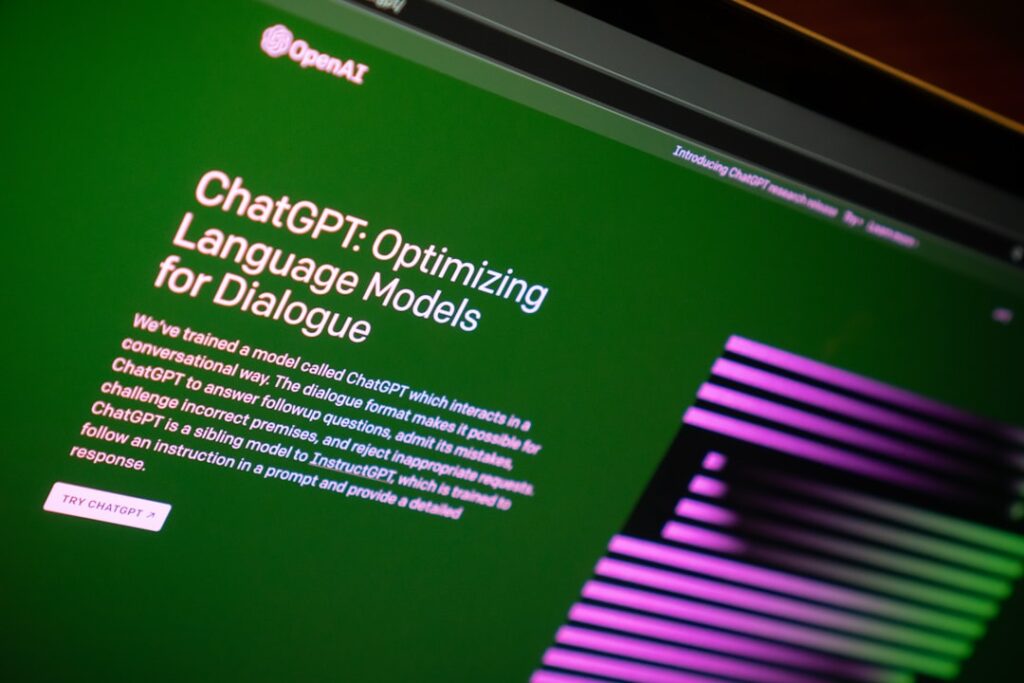
On May 7, 2026, OpenAI launched a training spec aimed at boosting large-scale AI computing. According to the company, the protocol is designed to improve GPU performance as AI compute ramps up. This is a significant move, considering that AI training requires immense computational resources, often straining even the most powerful hardware.
Key Takeaways
- OpenAI has developed a training spec for large-scale AI computing.
- The protocol aims to enhance GPU performance for AI training.
- The move is significant for the AI industry, which relies heavily on computational resources.
- The training spec could lead to faster and more efficient AI training.
- The impact of the training spec on the AI industry is yet to be seen.
Background and Motivation
OpenAI’s new training spec is part of the company’s ongoing efforts to make large-scale AI more accessible and efficient. The move is a response to the growing demand for AI computing, which requires immense computational resources. Over the past decade, AI models have grown exponentially in size and complexity. In 2018, models like GPT-2 had around 1.5 billion parameters. By 2023, GPT-4 surpassed 1 trillion, pushing hardware limits to the edge. Training runs now span weeks or even months, consuming millions of GPU hours and costing tens of millions of dollars per model.
The strain isn’t just on OpenAI. Across the industry, companies face bottlenecks in scaling. Even with access to thousands of GPUs, inefficiencies in communication, memory use, and load balancing cut into effective throughput. In 2025, reports surfaced that some training jobs achieved less than 40% utilization of available GPU capacity—meaning more than half the hardware sat idle during critical phases. These inefficiencies compound at scale, making each new generation of models more expensive and harder to justify.
OpenAI’s motivation isn’t just technical—it’s economic and strategic. As AI becomes central to enterprise software, cloud services, and consumer applications, the ability to train models faster and cheaper translates directly into a competitive edge. Reducing training time by even 20% could shave weeks off development cycles and cut cloud spending by millions. That kind of efficiency gain isn’t incremental—it’s significant.
The company has been refining its infrastructure for years. In 2024, OpenAI partnered with Microsoft to deploy one of the world’s largest AI supercomputers, built on tens of thousands of NVIDIA H100 GPUs. But hardware alone isn’t enough. Without optimized software protocols, even the most advanced clusters can’t operate at peak efficiency. The training spec is the next logical step: a software-defined framework to squeeze more performance out of existing hardware.
The Training Spec
The training spec announced by OpenAI is designed to optimize GPU performance for AI training. According to the company, the protocol is the result of extensive research and development. The move is aimed at making large-scale AI computing more accessible and efficient. While OpenAI hasn’t released the full technical documentation, early details suggest the spec focuses on three core areas: inter-GPU communication, memory allocation during forward and backward passes, and dynamic batch scheduling.
In large-scale training, GPUs must constantly exchange gradients and model states. This communication happens over high-speed interconnects like NVLink or InfiniBand, but inefficiencies arise when data transfer isn’t synchronized or when topology mismatches occur. The training spec introduces a standardized communication blueprint that aligns with common cluster configurations, reducing latency and avoiding bottlenecks during all-reduce operations.
Memory management is another critical area. Modern models often exceed the VRAM capacity of individual GPUs, requiring techniques like model parallelism and gradient checkpointing. The spec defines a consistent approach to partitioning model layers and managing temporary activations, which reduces memory spikes and prevents out-of-memory crashes during long training runs.
Perhaps most impactful is the dynamic batch scheduling component. Traditional training uses fixed batch sizes, but that doesn’t account for variable GPU availability or network congestion. The new protocol allows the system to adjust batch sizes on the fly, balancing throughput and stability. This could make training more resilient in shared or cloud environments, where resources fluctuate.
OpenAI says the spec is designed to be hardware-agnostic, though it’s optimized for clusters using NVIDIA GPUs and RDMA-capable networking. It’s not a standalone product—it’s a set of guidelines and reference implementations that developers can integrate into their training pipelines. The company has shared early versions with select partners, including research labs and cloud providers, but public release details are still unclear.
Impact on the AI Industry
The training spec announced by OpenAI could significantly impact the AI industry. The move could lead to faster and more efficient AI training, which would be a major breakthrough. However, the actual impact of the training spec is yet to be seen. If widely adopted, it could become a de facto standard, much like how TensorFlow and PyTorch shaped deep learning frameworks in the 2010s.
Standardization lowers barriers. Right now, every major AI lab uses custom training setups—some built on PyTorch, others on JAX, many with proprietary modifications. This fragmentation makes collaboration difficult and slows down progress. A shared training spec could unify best practices, allowing teams to reproduce results more reliably and scale models with greater confidence.
Cloud providers may also benefit. Companies like AWS, Google Cloud, and Azure offer AI-optimized instances, but performance varies depending on how customers configure their workloads. With a clear training spec, cloud vendors could pre-tune their infrastructure and offer “certified” training environments that guarantee performance levels. That would make AI training more predictable and easier to budget for enterprise clients.
Smaller players stand to gain too. Startups without massive engineering teams often struggle to optimize training at scale. A well-documented spec could let them piggyback on OpenAI’s research, achieving performance closer to industry leaders without reinventing the wheel. That could accelerate innovation across the sector, not just within well-funded labs.
Still, adoption isn’t guaranteed. Some organizations may resist standardization, preferring to maintain control over their training pipelines. Others may question OpenAI’s influence over foundational AI infrastructure. The company has a history of shifting from open to closed models—remember when GPT-2 wasn’t released due to misuse concerns, or when OpenAI initially open-sourced then restricted access to certain models? That track record could make some wary of depending too heavily on a spec controlled by a single entity.
What This Means for You
The OpenAI training spec could have significant implications for developers and builders. If the protocol is successful, it could lead to faster and more efficient AI training, which would be a major breakthrough. However, the actual impact is yet to be seen.
For developers and builders, the OpenAI training spec could be a game-changer. It could enable the creation of more complex AI models, which would be a major breakthrough. However, the actual impact is yet to be seen. To take advantage of the training spec, developers and builders will need to adapt their workflows and tools.
Consider a startup building a custom language model for legal document analysis. Today, they might train on a cluster of 64 GPUs, but due to poor communication efficiency and memory leaks, they’re only getting the equivalent output of 30 fully used GPUs. With the new training spec, they could see a 30–40% boost in effective throughput. That means cutting training time from six weeks to four, reducing cloud costs by $150,000, and getting to market faster. For a cash-strapped startup, that’s a lifeline.
Another scenario: a research team at a university working on multimodal AI. They have limited access to hardware and rely on shared compute resources. Right now, their training jobs often fail due to memory issues or network timeouts. The training spec’s dynamic scheduling and memory management rules could make their work more stable, allowing them to run longer experiments without constant debugging. That increases research velocity and makes it easier to publish reproducible results.
For enterprise developers integrating AI into existing products, the spec could simplify scaling. Imagine a software company adding real-time AI features to a customer support platform. They need to retrain models weekly with new data. Faster, more reliable training means fresher models in production, better accuracy, and fewer service disruptions. The spec could help them standardize across teams, reducing the engineering overhead of maintaining custom training scripts.
Competitive Landscape
While OpenAI is leading the charge, it’s not the only player focused on training efficiency. Google has long optimized its internal AI infrastructure, using TPUs and custom software stacks to train models like Gemini. In 2025, they introduced a new version of their Mesh-TensorFlow framework with automated sharding, which handles model distribution across hardware more efficiently. Meanwhile, Meta has pushed hard on open-source tools through PyTorch, recently adding features like distributed checkpointing and improved tensor parallelism.
NVIDIA, though not a direct competitor in model development, matters. The company provides the hardware that powers most large-scale training and has invested heavily in software like CUDA, NCCL, and TensorRT. In 2026, NVIDIA launched its own cluster optimization toolkit, offering performance tuning for multi-GPU setups. While complementary to OpenAI’s spec, it also suggests that hardware vendors are stepping deeper into software optimization—potentially competing with AI labs for influence over training standards.
Then there’s the open-source community. Projects like DeepSpeed from Microsoft and FlexFlow from Stanford offer alternative approaches to scaling AI training. These tools emphasize flexibility and customization, appealing to researchers who want fine-grained control. OpenAI’s spec may not replace them, but it could absorb some of their best ideas or push them to adapt.
The real question is whether OpenAI’s spec becomes widely adopted or remains a niche tool. Success depends on transparency, ease of integration, and perceived neutrality. If OpenAI opens the spec fully and encourages community input, it could gain momentum. If it’s seen as a proprietary lock-in strategy, adoption may stall.
Looking Ahead
The OpenAI training spec is a significant move in the AI industry. It could make large-scale AI computing more accessible and efficient. However, the actual impact is yet to be seen. As the AI industry continues to evolve, it will be interesting to see how the training spec is adopted and used.
: the OpenAI training spec is a significant move in the AI industry. It could make large-scale AI computing more accessible and efficient. However, the actual impact is yet to be seen.
Sources: AI Business