




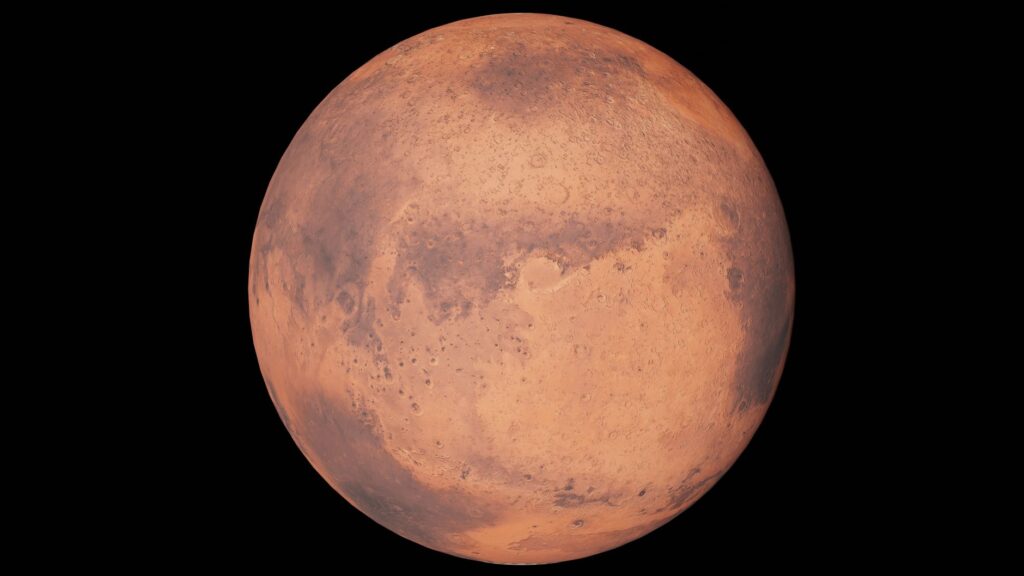
NASA will fly the Aeolus payload to Mars in 2028, and it’s doing so with a company that’s still learning how to get its rockets off the pad.
Key Takeaways
- Relativity Space, led by former Google CEO Eric Schmidt, wins the contract to launch NASA’s Aeolus payload to Mars.
- The Aeolus payload will deliver the first integrated daily global view of Martian winds, temperatures, dust, and clouds.
- Four instruments on the payload aim to improve entry, descent, and landing systems for future crewed missions.
- Relativity’s larger Terran R rocket, not yet flown, will handle the mission under a new public‑private partnership.
- Schmidt became Relativity’s CEO in 2025, two years after the company’s first 3D‑printed rocket, Terran 1, failed shortly after launch.
Relativity Space Mars Mission Overview
It’s a bold move for NASA to place its trust in a firm that only last year rolled out its first launch‑ready vehicle. The agency’s decision hinges on Relativity’s promise to provide the “spacecraft, rocket, and cruise operations” needed to get Aeolus to the Red Planet. That package, the original report notes, is part of a public‑private partnership that blurs the line between government and commercial exploration.
Why Aeolus Matters
Because the payload’s four instruments will give scientists the first continuous, global picture of Martian atmospheric dynamics, it isn’t just a cool data dump. NASA says the information will “directly inform entry, descent, and landing systems and support safer, more predictable mission planning for astronauts.” That quote underscores how crucial atmospheric data is for the next generation of crewed landings, where a sudden dust storm could mean the difference between a safe touchdown and a catastrophic abort.
Historical Context
NASA’s partnership model has evolved dramatically over the past two decades. Early in the 2000s, the agency began outsourcing cargo flights to commercial operators, a shift that opened the door for private firms to take on more ambitious tasks. Since then, several private launch providers have earned NASA contracts for lunar and deep‑space missions, but none have been asked to own an entire interplanetary payload from launch to cruise.
Relativity Space entered the market with a promise that set it apart: every major component of its rockets would be fabricated by additive manufacturing. The company’s first vehicle, Terran 1, lifted off in a test flight that ended in an early abort. The failure highlighted the steep learning curve of printing large, flight‑qualified structures, yet it also demonstrated that the technology could survive the rigors of launch.
Two years after that setback, the board appointed Eric Schmidt as chief executive. His arrival signaled a shift from pure engineering risk to a more strategic, business‑focused approach. Under his guidance, Relativity accelerated development of a larger, more capable launch system—Terran R. The new rocket is designed to carry heavier payloads and to reach beyond low‑Earth orbit, a capability that NASA specifically sought for the Aeolus mission.
Eric Schmidt’s Unlikely Turn to Rocketry
Everyone knows Eric Schmidt as the former Google CEO who steered the company from 2001 to 2011. What’s less known is that he took the helm at Relativity Space in 2025, after the firm’s first 3D‑printed rocket, Terran 1, failed shortly after launch. The failure didn’t stop the company from eyeing bigger ambitions; its next‑generation Terran R, a larger vehicle designed for deep‑space missions, is slated for its inaugural flight later this year.
From 3D‑Printed Rockets to Mars
Relativity’s claim to fame—printing rockets layer by layer—has always been a double‑edged sword. The technology promises rapid iteration, but the Terran 1 mishap showed that the approach still has teething problems. Yet the agency’s confidence suggests that the company’s engineering team has ironed out enough of those bugs to earn a multi‑year, multi‑billion‑dollar contract.
Technical Architecture of the Mission
Under the public‑private partnership, Relativity will deliver a complete mission stack. The spacecraft bus that houses Aeolus will be manufactured alongside the launch vehicle, using the same 3D‑printing processes that define the company’s core competency. Integrating the bus and the rocket reduces the number of mechanical interfaces, an advantage when a mission must survive a six‑month cruise through deep space.
Cruise operations will be handled by Relativity’s autonomous navigation team. Instead of relying on NASA’s Deep Space Network for every maneuver, the company will employ onboard software that can process trajectory corrections in real time. This approach mirrors the trend toward more self‑contained spacecraft, where ground stations provide oversight but do not dictate every course adjustment.
The Terran R itself will feature a larger propellant tank, a more powerful engine cluster, and a payload fairing sized to accommodate the Aeolus instrument suite. Although the rocket has yet to complete a flight, its design draws on the lessons learned from Terran 1’s abort, reinforcing structural margins and adding redundancy to critical systems.
Public‑Private Partnership: What’s Changing?
NASA isn’t just buying a launch service; it’s handing over the whole mission architecture. The partnership means Relativity Space will handle the spacecraft that houses Aeolus, the rocket that lifts it off Earth, and the cruise operations that steer it across interplanetary space. That’s a departure from the agency’s traditional model, where it would retain spacecraft design while contracting only the launch vehicle.
- NASA provides the scientific payload (Aeolus) and mission objectives.
- Relativity Space supplies the launch vehicle (Terran R) and spacecraft bus.
- The company also manages cruise navigation, a role usually reserved for NASA’s Deep Space Network.
Implications for the Space Industry
Because the contract hands over so much to a single commercial player, it could set a precedent for future deep‑space missions. If the Aeolus data proves valuable, other agencies might follow suit, pressuring more startups to develop end‑to‑end solutions rather than just launch services. That could accelerate consolidation in the sector, as firms scramble to offer complete mission packages.
Risk and Reward
There’s a risk factor that can’t be ignored. The Terran R hasn’t flown yet, and NASA is betting on a launch vehicle that’s still in testing. But the reward—steady, daily Martian weather maps—could be a game‑changer for human exploration, especially when you consider the thin Martian atmosphere and the challenges it poses for landing.
What This Means For You
If you’re a developer building tools for planetary data, the Aeolus payload opens a new stream of high‑frequency, global datasets. You’ll need to design pipelines that can ingest, store, and serve daily atmospheric measurements, potentially integrating with existing Earth‑weather APIs to provide comparative insights.
For founders, the story signals that NASA is willing to entrust whole mission architectures to commercial partners. That means opportunities for startups that can deliver spacecraft integration, autonomous navigation, or even low‑cost deep‑space communication services. Position your technology to plug into a mission‑wide contract, and you could find a government customer willing to fund ambitious R&D.
Imagine a SaaS platform that visualizes dust storm trajectories in near‑real time. With Aeolus delivering fresh data every day, such a service could become indispensable for mission planners, research labs, and even educational outreach programs. Another scenario involves a data‑analytics firm that builds predictive models of Martian temperature swings; those models could feed into landing‑site selection tools for future crewed missions.
As the launch window for 2028 approaches, one thing’s clear: the success or failure of Terran R will echo far beyond one payload. Will it prove that a 3D‑printed rocket can reliably carry scientific instruments across interplanetary space, or will it reinforce the need for more proven launch options? Only.
Key Questions Remaining
Several unknowns still hover over the mission. First, how will the integration of Aeolus with the Terran R bus be validated before the deep‑space flight? Second, what contingency plans exist if the cruise navigation software encounters an unexpected anomaly? Third, how will NASA’s own teams coordinate with Relativity’s engineers during the critical entry, descent, and landing phases, given that the payload’s data will directly influence those operations?
Answers to these questions will shape not only this particular Mars venture but also the broader template for future public‑private collaborations. The aerospace community will be watching closely, ready to adapt its own strategies based on the outcomes.
Sources: The Verge, TechCrunch